The deployment of Large Language Models (LLMs) and other AI agents involves significant logistical and technical efforts that are often overlooked. While these systems are frequently viewed as creative tools, the reality is that their implementation requires substantial programming, optimization, and constant adaptation to evolving environments. Semantic analytics applications, such as declarative optimization, play a crucial role in ensuring that programs run efficiently across different settings. This necessity for adaptability harks back to the 1970s when database engineers had to manage similar challenges. Today’s AI programmers must navigate an ever-changing landscape of new hardware, GPUs, services, and tools, which can be overwhelming. According to MIT Research Scientist Michael Cafarella, programmers must balance goals such as speed, cost, and quality, while managing vast amounts of data. Systems like Palimpzest exemplify how automation can streamline operations and reduce manual tasks. As computational limits are reached, declarative optimization could be key to advancing AI technology further.
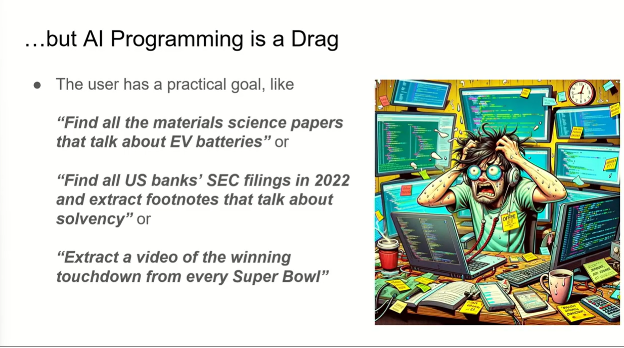
AI Programming – The Hidden Challenges Behind the Scenes
AI programming involves complex logistics and constant adaptation to new tools and environments.
1–2 minutes

TOP STORIES

The Pentagon has secured agreements with tech giants to enhance military AI capabilities, raising ethical concerns about its use in …

The legal clash over AI safety and profit motives highlights critical concerns …

Meta’s acquisition of ARI aims to boost its humanoid robotics and AI development …

The trial between Elon Musk and OpenAI reveals deep divisions over AI’s future and ethical commitments …

The U.S. Defense Department expands its AI partnerships to enhance military capabilities …

Apple’s Mac revenue outperformed expectations, driven by strong AI demand and new product launches …