
Innovative Approach to Corrosion Prevention
This study presents a machine learning model designed to predict effective organic corrosion inhibitors for aluminum alloys. The researchers developed a classification algorithm to distinguish compounds with high corrosion inhibition efficiency (>70%) from less effective ones.
Key Aspects of the Model:
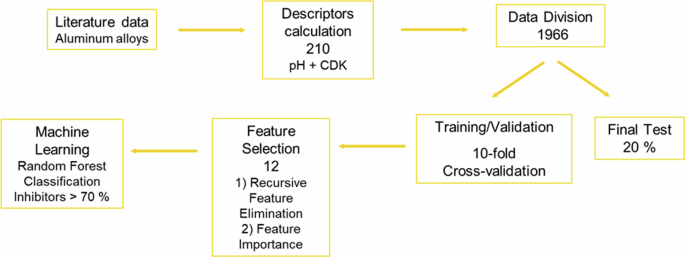
- Utilizes a dataset of 1,966 corrosion inhibition efficiencies for 173 organic compounds
- Employs the random forest algorithm for classification
- Considers pH as a categorical feature along with 9 molecular descriptors
- Achieves 73% cross-validation accuracy and 74% balanced accuracy
Model Development and Validation:
- Data split: 80% for training/cross-validation, 20% for independent testing
- Feature selection through recursive feature elimination and random forest importance
- 10-fold cross-validation for model optimization
- Final evaluation on unseen test data
Why It Matters
This machine learning approach offers a rapid virtual screening method for potential corrosion inhibitors, accelerating the discovery process for eco-friendly protective compounds. The model’s ability to consider diverse experimental conditions and compounds makes it a valuable tool for researchers in materials science and corrosion prevention.
The accompanying DATACORTECH web application allows users to easily input molecular structures and predict their corrosion inhibition potential, bridging the gap between computational modeling and practical application in corrosion science.





