Illuminating the Future of Solar Energy
Solar energy forecasting is crucial for efficient power grid management and renewable energy integration. This study explores advanced forecasting techniques for solar irradiance, combining artificial intelligence (AI) models with uncertainty analysis. The research focuses on three key areas:
Forecasting Methods and Models
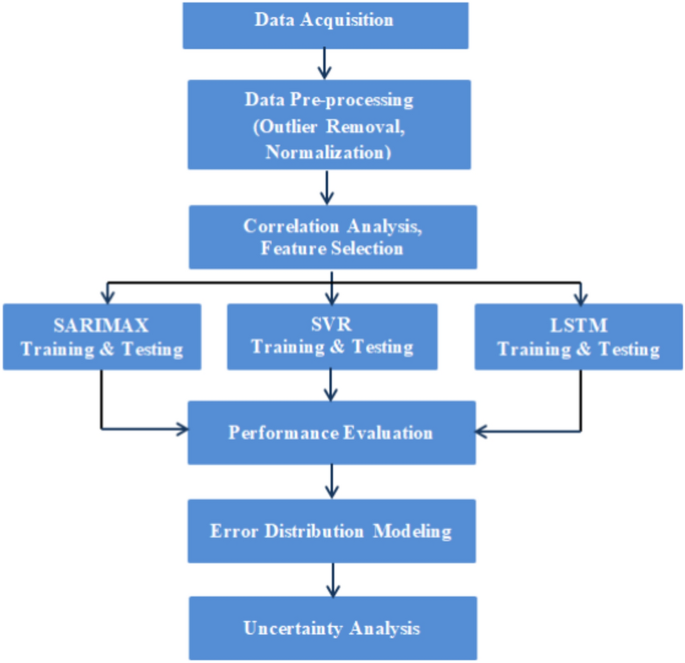
- The study employs three AI models for seasonal forecasting of hourly solar irradiance: SARIMAX (Seasonal AutoRegressive Integrated Moving Average with eXogenous variables), SVR (Support Vector Regression), and LSTM (Long Short-Term Memory).
- These models are applied to data from a specific location in Bangalore, Karnataka, India, demonstrating their effectiveness in real-world scenarios.
- The research highlights the importance of both direct (solar power output) and indirect (irradiance) forecasting approaches.
Error Modeling and Uncertainty Quantification
- The seasonal forecast errors are modeled using a parametric Laplace distribution, providing a statistical framework for understanding prediction inaccuracies.
- The study emphasizes the importance of quantifying forecast uncertainty through confidence levels and coverage rates, moving beyond simple point forecasts.
- This approach allows for a more nuanced understanding of potential solar energy output ranges, crucial for grid operators and energy planners.
Bridging the Gap in Solar Forecasting Research
The study addresses several key gaps in current solar forecasting literature:
- It focuses on solar irradiance forecasting uncertainty, an area that has received less attention compared to wind energy forecasting.
- The research combines point forecasting with interval forecasting, providing a more comprehensive view of potential solar energy output.
- By conducting both forecasting and uncertainty analysis, the study offers valuable insights for improving solar energy integration into power grids and microgrids.
This research contributes to the growing body of knowledge on solar energy forecasting, emphasizing the need for more sophisticated prediction models and uncertainty quantification in the renewable energy sector.