Understanding the Essence of Place Identity
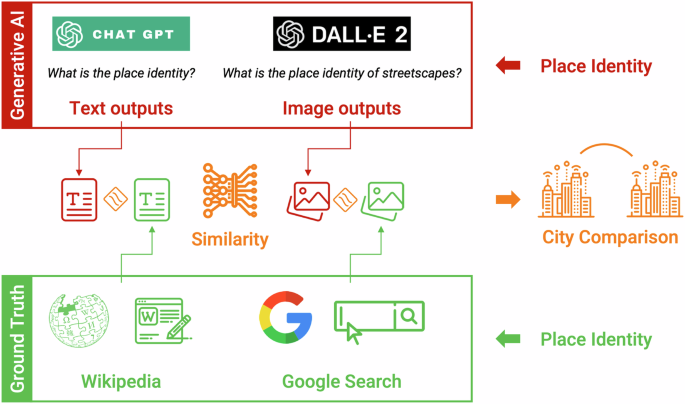
The exploration of place identity through Generative AI (GenAI) reveals how these models can encapsulate the unique characteristics and meanings associated with different locations. While GenAI, like ChatGPT and DALL·E2, shows promise in generating content and images reflective of urban settings, concerns about their reliability and accuracy persist. This study aims to evaluate the trustworthiness of GenAI outputs, particularly in relation to place identity, using datasets like Wikipedia and Google images as benchmarks. The absence of a global ground-truth dataset for place identity complicates this evaluation, making it crucial to assess how well GenAI captures the essence of urban environments.
Key Findings
- ChatGPT articulates place identity effectively, linking it to social, cultural, and historical elements.
- Generated outputs align with public perceptions of cities, highlighting significant landmarks and cultural aspects.
- DALL·E2 produces images that visually represent city identities, but some outputs lack accuracy when compared to real-world images.
- Cosine similarity scores indicate varying levels of alignment between GenAI-generated and Wikipedia descriptions, revealing both strengths and weaknesses in content generation.
Significance of the Research
This research underscores the potential of GenAI in urban studies while emphasizing the need for critical evaluation of its outputs. By comparing generated content with established datasets, the study highlights the models’ ability to reflect place identity, which is essential for urban planning, cultural preservation, and community engagement. Understanding the nuances of place identity through GenAI can inform better decision-making and foster a deeper connection between people and their environments, ultimately contributing to more meaningful urban experiences.