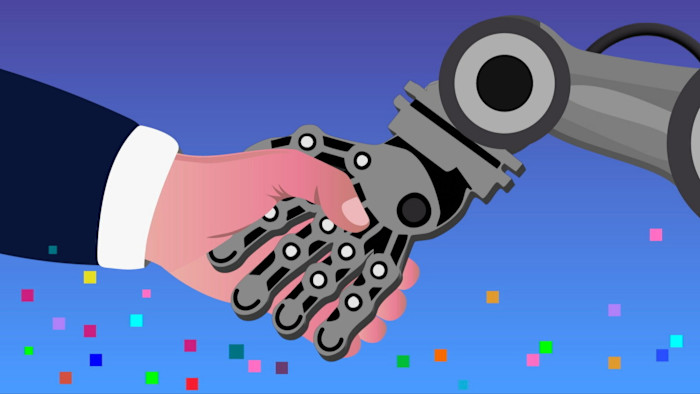
The article explores the evolving landscape of artificial intelligence, particularly focusing on the concept of test-time scaling. This innovative approach allows AI systems to dynamically adjust their cognitive resources to meet real-time task demands, much like humans do in their daily decision-making. The discussion highlights the ongoing debate around scaling laws in AI development, with experts divided on whether these laws are consistent or evolving. Some believe that simply increasing computational resources will continue to yield better performance, while others argue that new strategies are necessary to overcome current limitations.
Key insights include:
- The importance of test-time scaling for enhancing AI performance in real-time tasks.
- Jensen Huang’s analogy comparing AI learning stages to human education, emphasizing the difference between training and real-time application.
- Techniques like ensemble learning and input adjustments that allow AI models to optimize their performance based on task complexity.
- The ARC dataset as a benchmark for AI creativity, showcasing the gap between human and AI capabilities in abstract reasoning.
Understanding these advancements is crucial as they signify a shift in how AI systems operate, moving towards a more human-like cognitive approach. This evolution could lead to AI that not only processes information but also adapts and learns in real-time, ultimately transforming various industries and enhancing human-machine collaboration.