Understanding the Challenge
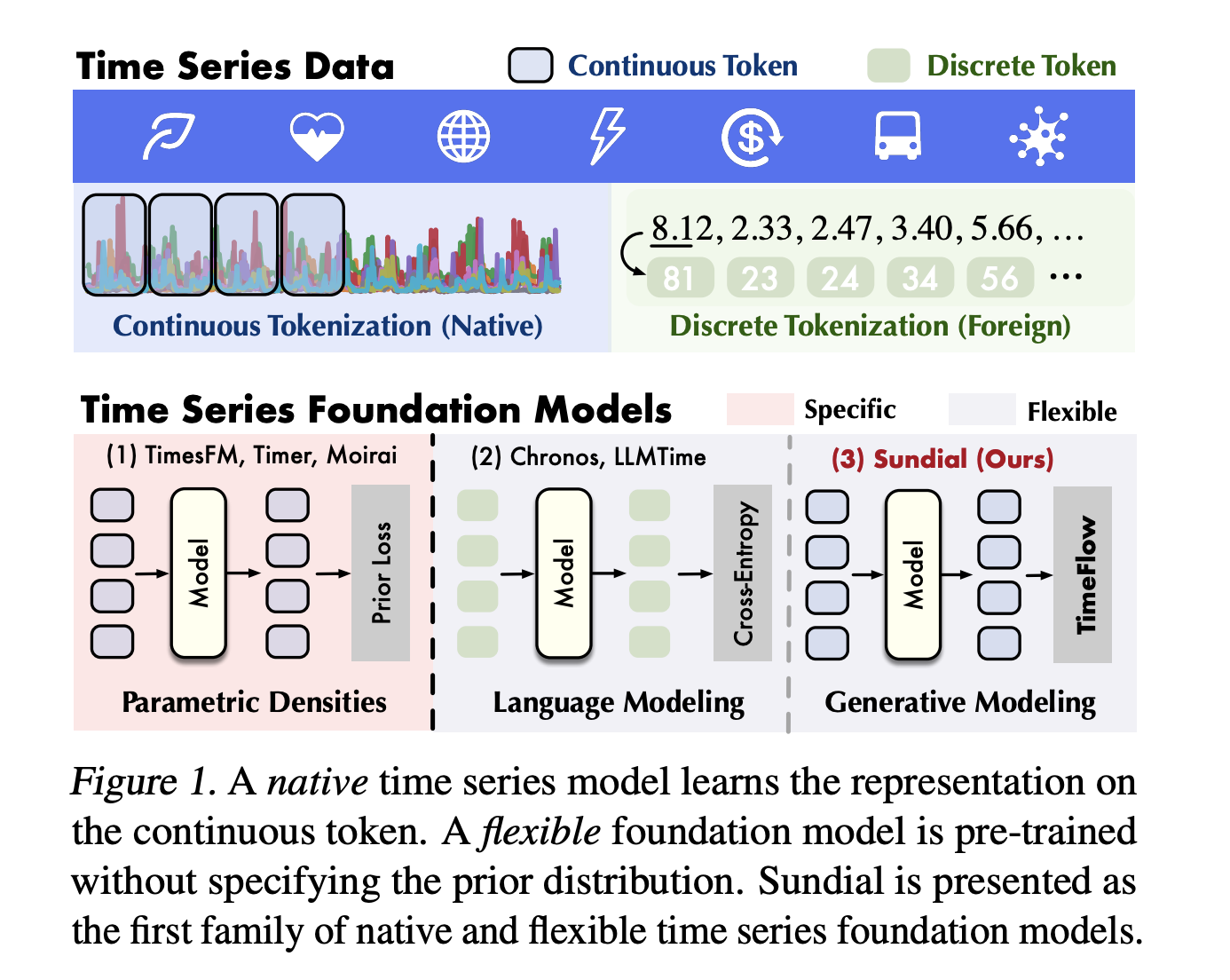
Time series forecasting is inherently complex due to its unpredictable nature. Traditional forecasting methods often focus on providing a single value, which fails to capture the uncertainty and range of possible outcomes. Recent advances in deep learning have improved accuracy but often require specific training for each task and struggle to generalize across different data distributions. Current models either impose strict assumptions or use discrete tokenization, leading to issues like out-of-vocabulary errors and quantization inaccuracies. Addressing these limitations is crucial for developing effective forecasting models that can adapt across various fields without needing extensive retraining.
Key Innovations of Sundial
- Sundial introduces a generative and flexible foundation model for time series forecasting.
- It utilizes continuous tokenization with native patching, preserving the continuity of time series data.
- The model employs TimeFlow Loss, a novel generative training objective that allows it to learn predictive distributions without prior assumptions.
- Trained on TimeBench, a massive dataset with one trillion time points, Sundial shows strong generalization capabilities across various forecasting tasks.
Implications for the Future
Sundial represents a major advancement in time series forecasting. It offers a more adaptable and efficient approach to understanding complex data patterns. By generating multiple potential future outcomes instead of a single prediction, it enhances decision-making in uncertain environments. Its ability to perform well in zero-shot scenarios and across different domains makes it a valuable tool for industries such as finance, healthcare, and IoT. This innovation not only improves accuracy but also redefines the potential of time series foundation models, paving the way for more reliable forecasting solutions.