
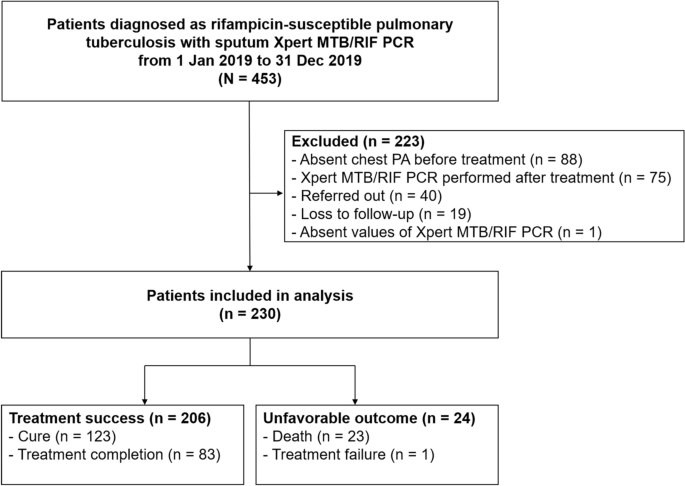
This study sheds light on the crucial role of chest imaging and artificial intelligence (AI) in diagnosing and managing pulmonary tuberculosis. The findings highlight the potential of AI-based models to calculate tuberculosis extent scores from chest X-rays, which can objectively evaluate the radiographic severity of the disease at diagnosis. Notably, the study found that the representative Ct values from the Xpert MTB/RIF assay at diagnosis were not significantly correlated with either treatment success or culture conversion rate at 8 weeks after treatment. The research underscores the importance of radiographic findings in managing pulmonary tuberculosis, particularly in predicting treatment outcomes. The study’s multicenter approach and utilization of AI-based models are significant strengths, but limitations include its retrospective nature and limited applicability to primary care settings. Future research should address these limitations and explore the relevance of other RT-PCR Ct values. Overall, the study demonstrates the potential of AI in revolutionizing pulmonary tuberculosis diagnosis and treatment.
AI-Powered Diagnosis – A Game-Changer in Pulmonary Tuberculosis Treatment
The use of AI in the diagnosis of pulmonary tuberculosis has been a subject of extensive research.
1–2 minutes

TOP STORIES

Obama stresses Democrats must prioritize AI safety and economic strategy …

Amodei’s call for caution in AI development highlights the need for safety and alignment …

Sony Music and Warner Music have sued Anthropic, accusing it of copyright infringement in AI training …

Huang believes Nvidia’s position in AI will lead to another year of record growth …

Anthropic’s report reveals a surge in distillation attacks by Chinese AI firms on U.S. models …

AI agents’ autonomy poses significant risks, as demonstrated by a recent breach …



