Researchers from Penn State, UCLA, Carnegie Mellon, and Argonne National Laboratory have made a groundbreaking discovery in using machine learning to forecast weather patterns. The team, led by Romit Maulik, assistant professor at Penn State, presented their paper, “Scaling transformer neural networks for skillful and reliable medium-range weather forecasting,” at the International Conference on Learning Representations (ICLR) and received the best paper award. The research explores the use of artificial intelligence (AI) tools for forecasting, which could potentially replace classical methods currently in use. The AI model, based on computer vision techniques, takes data from historical information such as archival forecasts and satellite images to learn weather patterns, allowing for real-time forecasts without requiring large computational resources. This breakthrough could lead to more accurate forecasting of weather extremes, which current models struggle to predict. Maulik emphasizes that their goal is to balance classical and machine learning methods, rather than being partial to either. This innovative approach could revolutionize the field of weather forecasting, providing a viable competitor to classical methods.
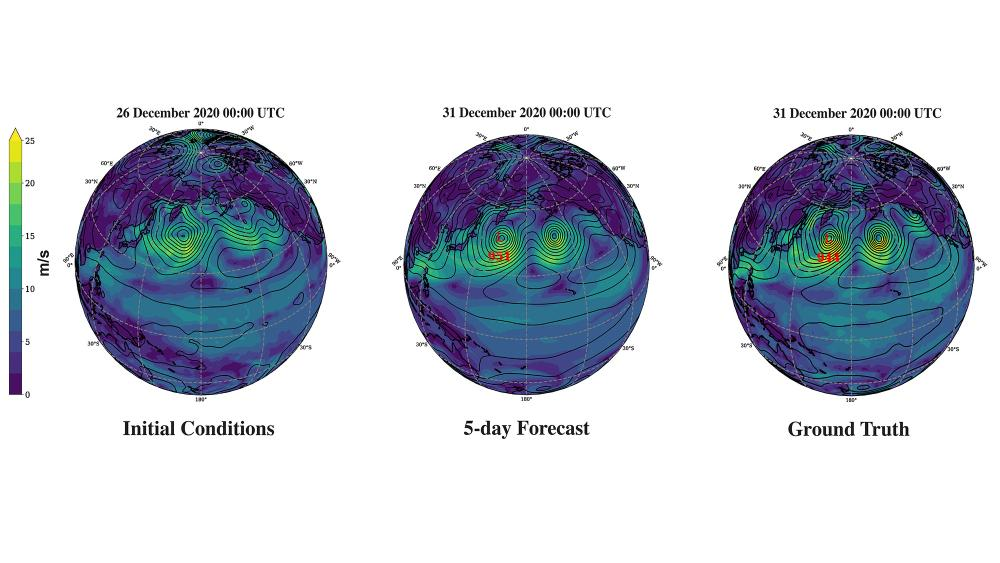
Machine Learning Forecast
Researchers are using machine learning to forecast weather patterns, potentially replacing classical methods currently in use.
1–2 minutes

TOP STORIES

U.K. regulations require Google to let publishers opt out of AI content use …

Microsoft launches Scout, an AI assistant designed for personalized productivity …

Microsoft launches Agent Control Specification to manage AI agent behavior …

Amazon’s Ring faces a class action lawsuit over alleged privacy violations involving its facial recognition feature …

Anthropic is expanding its Project Glasswing to 150 organizations globally to enhance cybersecurity …

Nvidia’s RTX Spark promises to change PC interactions by making AI more accessible …