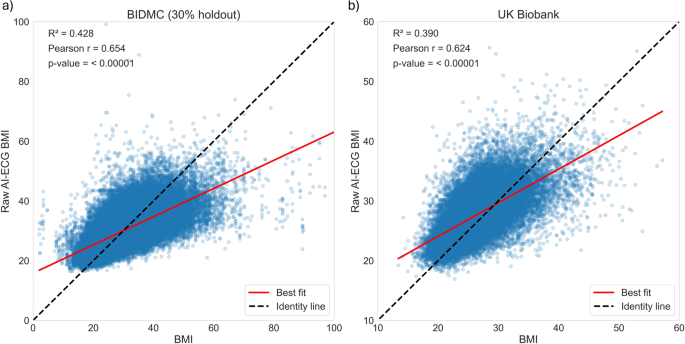
This study harnesses the power of artificial intelligence (AI) to develop an electrocardiogram (ECG)-based model that accurately predicts body mass index (BMI) and cardiometabolic disease risk. The AI-ECG BMI model, trained on over 1.1 million ECGs from two large cohorts, demonstrates a strong correlation with measured BMI and identifies individuals at high risk of developing cardiometabolic diseases, including type 2 diabetes, hypertension, and lipid disorders. The model’s performance is externally validated in an independent cohort, and its prognostic significance is confirmed through survival analysis. The study also explores the genetic, metabolomic, and proteomic associations of the AI-ECG BMI model, providing insights into the biological mechanisms underlying cardiometabolic disease. Overall, this innovative approach has the potential to revolutionize the field of cardiovascular medicine by enabling early identification and prevention of cardiometabolic diseases.
AI-ECG Predicts BMI and Cardiometabolic Disease Risk
The AI-ECG BMI model demonstrates a strong correlation with measured BMI and identifies individuals at high risk of developing cardiometabolic diseases.

TOP STORIES

Apple is tightening privacy controls on macOS to protect users from AI risks …

Trump consulted Musk’s Grok chatbot before military actions in Venezuela …

Google’s satellite launch aims to test its AI chips in space, paving the way for future orbital data centers …

OpenAI has dismissed three researchers for sharing confidential information with an outside organization …

Gemini 4 Argon is designed to excel in cybersecurity, coding, and visual analysis …

Project Meridian seeks to redefine warfare by leveraging advanced technology with the help of industry leaders …