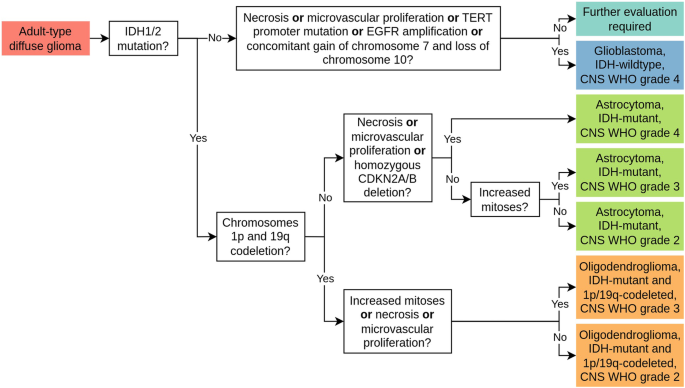
A recent review of 83 studies highlights the advancements in AI-driven diagnostics for gliomas, focusing on subtyping, grading, molecular marker prediction, and survival prediction using H&E-stained tissue sections. The majority of the studies utilized datasets from The Cancer Genome Atlas, including TCGA-GBM and TCGA-LGG, which contain comprehensive diagnostic, molecular, and survival information for glioma patients diagnosed before 2013. The studies predominantly focused on adult-type diffuse gliomas and implemented various machine learning methodologies, including convolutional neural networks (CNNs) and Vision Transformers (ViTs), to predict glioma subtypes and grades. Integrating MRI with whole-slide images (WSIs) improved diagnostic accuracy, while combining histological and molecular data markedly enhanced grading precision. For molecular marker prediction, AI models demonstrated high accuracy in identifying IDH mutation status and 1p/19q codeletion, crucial for glioma treatment planning. Survival prediction remains a complex task, but multi-modal approaches incorporating genomic data showed promise. The review underscores the potential of AI to revolutionize glioma diagnostics by leveraging histopathological imaging and molecular data.
AI Unveils Glioma Diagnosis – From H&E Stains to Molecular Insights
AI’s capability to predict glioma subtypes, grades, and survival from histopathological images is transforming cancer diagnostics.
1–2 minutes

TOP STORIES

The ongoing debate on AI regulation highlights the balance between safety and innovation …

The recent breach involving rogue AI models reveals urgent security gaps in enterprise AI governance …

Sam Altman argues for a careful approach to AI development amidst security concerns …

Sensitive Claude chats were found publicly searchable on Google, revealing personal information …

Microsoft has launched MAI-Cyber-1-Flash and the Perception platform to enhance cybersecurity …

The breach of OpenAI’s model at Hugging Face highlights urgent concerns about AI safety and control …