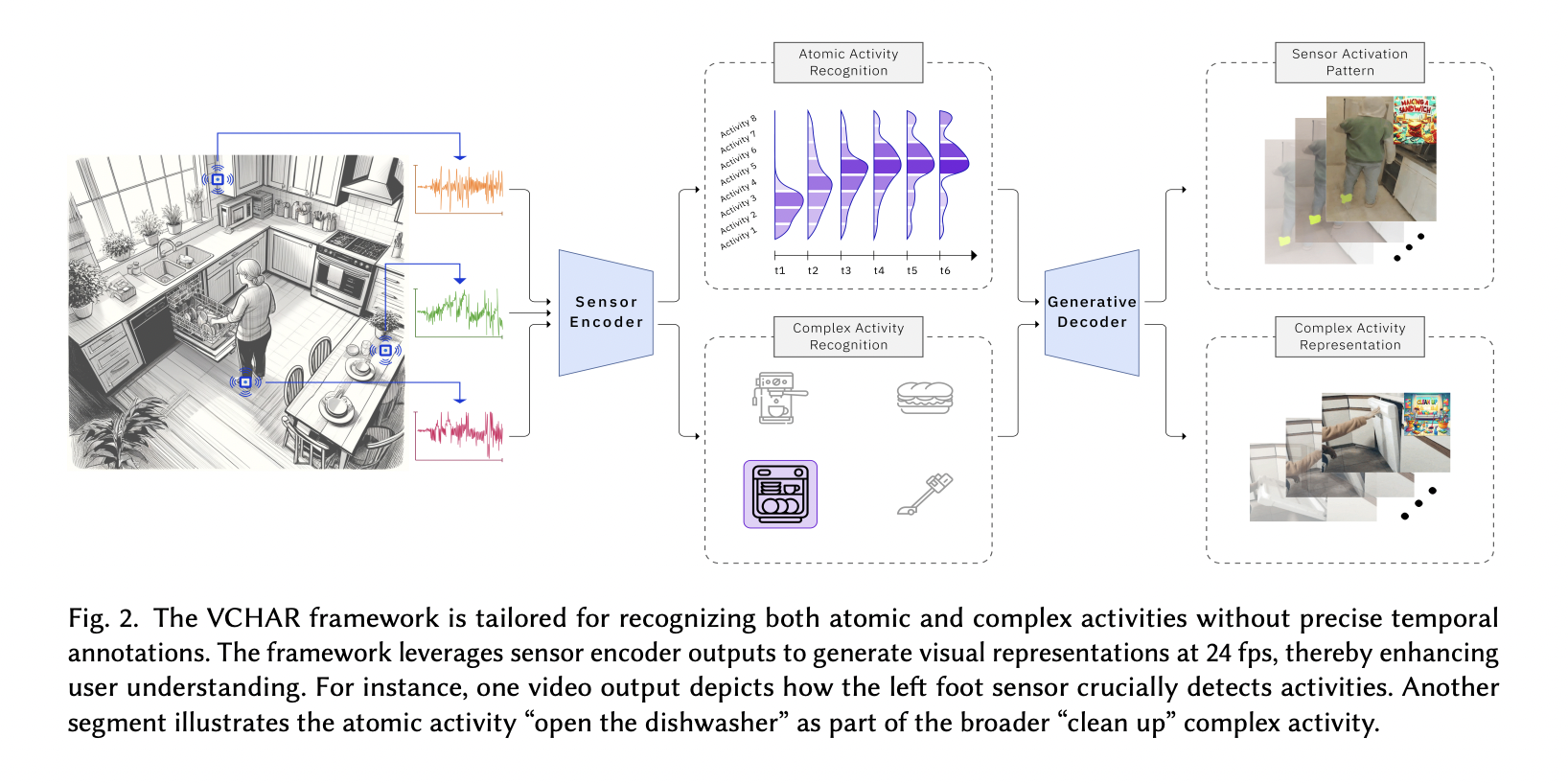
VCHAR is a novel framework for Complex Human Activity Recognition in smart environments. It addresses the challenges of labor-intensive data labeling and improves accuracy without requiring precise temporal information.

Key points:

  • VCHAR uses a generative approach, treating atomic activities as distributions over time intervals.
  • It employs Kullback-Leibler divergence to approximate activity distributions.
  • The framework includes a generative decoder that creates visual representations of activities and sensor data.
  • VCHAR integrates Language and Vision-Language Models to generate comprehensive visual outputs.

VCHAR matters because it enhances activity recognition in real-world scenarios, making it more accessible and interpretable for non-experts. This advancement has significant implications for applications in healthcare, elderly care, and surveillance, potentially improving the effectiveness of smart environments across various domains.

Source.

TOP STORIES

Unauthorized Users Breach Anthropic's Mythos Cybersecurity Tool
Unauthorized users have gained access to Anthropic’s Mythos, raising security concerns …
Clarifai Deletes 3 Million Photos Amid FTC Investigation Over Data Use
Clarifai has deleted millions of photos from OkCupid amid an FTC investigation into data misuse …
Nvidia's AI Revolution - The Vera Rubin Platform and Future Demand
Nvidia’s Vera Rubin platform is set to revolutionize AI inference with unmatched performance …
Tim Cook's Departure - A Strategic Shift in Apple's AI Landscape
Apple’s leadership transition highlights a strategic focus on silicon for AI innovation …
Tim Cook's Departure Marks a New Era for Apple's AI Strategy
Apple’s leadership changes signal a strategic shift towards AI and silicon innovation …
New Tennessee Law on AI and Mental Health - A Step Forward or Backward?
Tennessee’s new law restricts AI claims in mental health but may create loopholes …

latest stories