Revolutionizing Clean Energy Storage
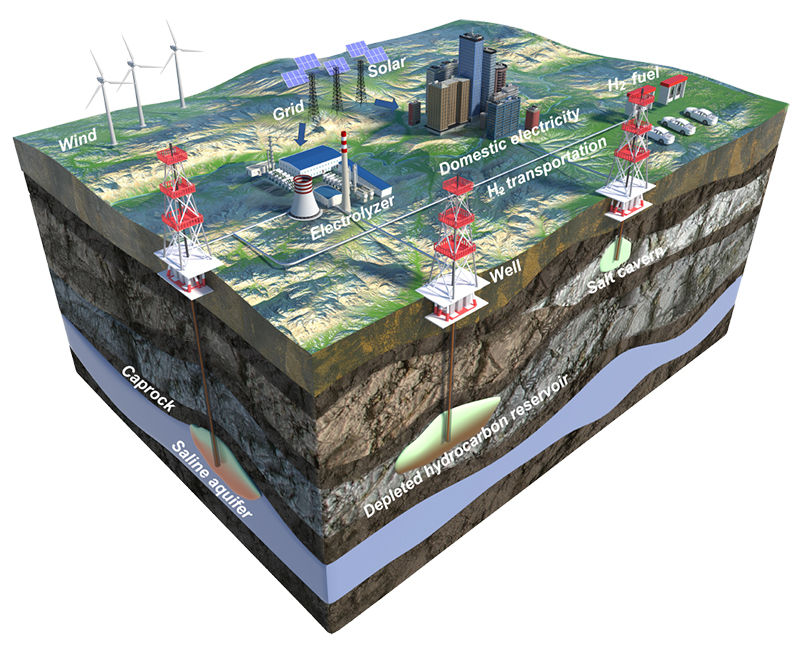
Los Alamos National Laboratory scientists are pioneering advanced machine learning models to simulate underground hydrogen storage operations. This groundbreaking research is crucial for developing efficient and safe storage solutions for hydrogen, a key player in the future low-carbon economy. The team’s focus on cushion gas scenarios provides valuable insights into optimizing storage performance in deep saline aquifers and depleted hydrocarbon reservoirs.
Key Findings and Innovations
- Deep neural network models analyze various geological and operational parameters to mimic real-world scenarios
- Underground hydrogen storage in porous rocks shows improved performance over cycles
- Different cushion gases (methane, carbon dioxide, nitrogen) impact hydrogen recoverability, purity, and water production risk
- The research addresses challenges in maximizing hydrogen recoverability and purity while mitigating water production risks
Paving the Way for a Hydrogen-Powered Future
This research is a critical step towards scaling up the hydrogen economy, which is essential for decarbonizing various sectors. By developing tools like OPERATE-H2, the first industry-available software integrating advanced machine learning for hydrogen storage optimization, Los Alamos is leading the charge in making underground hydrogen storage economically viable. This work not only advances our understanding of hydrogen storage but also contributes to the broader goal of creating a sustainable and resilient clean energy infrastructure.